
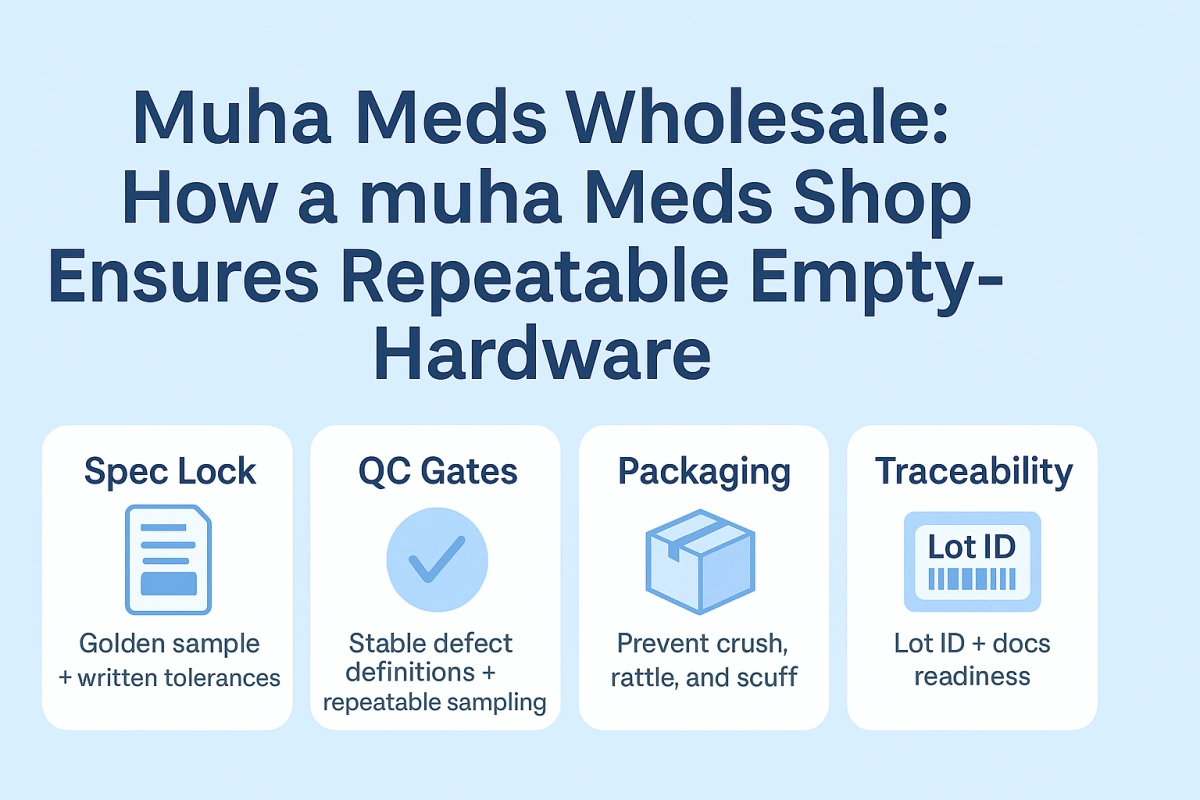
muha meds wholesale: How a muha meds shop Ensures Repeatable Empty-Hardware
B2B Repeatable QC Packaging & Traceability Docs-Ready Shipping
In bulk purchasing, “quality” is not the best-looking sample on a desk. It’s the ability to reorder the same SKU, receive the same build consistency, and keep the sellable rate stable across cartons and lots. That’s why a modern wholesale program behaves more like an operating system: it locks specs, runs QC gates, hardens packaging for the real shipping environment, and keeps traceability tight enough to isolate problems fast.
If you’re sourcing Muha Meds bulk inventory, the goal is not “cheap once,” but predictable batches you can stand behind. A scalable muha meds wholesale program is built on repeatable inspection and clear defect rules. And a reliable muha meds shop wins by turning those controls into fewer returns, faster reorders, and cleaner customer expectations.
1) Define “repeatable quality” for empty-hardware
What repeatable quality looks like
- Same SKU behavior across lots: assembly feel, fit, finish, and packaging alignment stay stable.
- Lower return drivers: fewer cosmetic rejects, fewer DOA electronics, fewer “arrived unsellable” cartons.
- Comparable quoting: suppliers quote the same assumptions (pack-out, QC method, carton counts).
- Evidence trail: lot IDs + QC reports support disputes and continuous improvement.
What repeatable quality is NOT
- Not a one-time perfect sample that can’t be repeated in production.
- Not “lowest price wins” without defect rules and packaging protection.
- Not a catalog full of near-duplicate SKUs with no spec control.
- Not “trust me” without traceability and documented checks.
Bulk win condition: low total cost per sellable unit — not “cheap once, expensive later.”
2) Spec lock: what to freeze before you scale
If you want fewer surprises in bulk, lock your spec sheet early. “Spec lock” means a stable written definition of the product and its packaging, plus a sealed “golden sample” that future lots must match.
Empty-hardware spec items to lock (practical)
- Cosmetics: color tolerance, seam alignment, scratch/scuff tolerance, print rub resistance.
- Assembly feel: button/airflow feel (if applicable), mouthpiece fit, seam consistency.
- Materials (declared): housing, mouthpiece, gasket type and placement (don’t accept “same as last time” verbally).
- Pack-out: insert/tray geometry, inner box structure, master carton counts and dividers.
- Label zones: barcode areas on flat, high-contrast spots (reduce scan failures and relabel labor).
Tip: treat any change in materials/packaging as a “new revision” that needs a mini pilot — even if the supplier calls it “no big change.”
3) QC gates: sample → pilot → production
Repeatability comes from disciplined gates. The goal is to turn quality decisions into a checklist, not a debate.
Gate A — Golden sample approval
Approve one sealed “golden” unit that represents cosmetics, assembly feel, and packaging dielines. Photograph it (standard angles) and store it. Every future lot is compared against this reference.
Gate B — Pilot run (variance detector)
A pilot run uses real production tooling and real packaging. Pilot success means your top failure modes are controlled: cosmetic abrasion, packaging crush risk, and any electronic DOA indicators you track.
Gate C — Production inspection (repeatable disposition)
Production QC should use written defect definitions (critical/major/minor). The “power move” is consistency: you want the same checks and reporting format for every shipment so supplier improvement is measurable and disputes are defensible.
4) Sampling plans (AQL-style): keeping inspection consistent
Many bulk buyers use acceptance sampling indexed by AQL to avoid 100% inspection and still control risk. ISO 2859-1 describes an acceptance sampling system for inspection by attributes—useful when you want a repeatable, lot-by-lot decision system instead of “look at a few boxes and hope.”
What to define in writing
- Defect classes: define what counts as critical vs major vs minor for your customers’ sellability standard.
- Sampling logic: specify the sampling approach and keep it stable across reorders.
- Evidence format: photos, counts, and a short conclusion tied to PO + lot ID.
The exact thresholds are your business decision; the value is the repeatability.
5) Packaging durability: what shipping actually breaks
Packaging is a protection system. Parcel delivery introduces drops, vibration, compression, and corner impacts. ISTA Procedure 3A is widely referenced as a parcel-delivery simulation for shipments up to 150 lb (70 kg), which makes it a practical benchmark mindset when you design cartons and inserts.
Common failure points in bulk
- Corner crush that ruins shelf presentation
- Loose inserts that allow internal rattle and abrasion
- Scuffing from friction during vibration exposure
- Labels placed on curves or low-contrast backgrounds
Simple packaging controls that scale
- Lock box structure + board grade
- Lock insert geometry to prevent motion
- Standardize carton pack count + dividers
- Design for edges/corners first
6) Traceability: lot IDs that protect reorders
Traceability is the difference between “everything is broken” and “this lot from this shipment had this defect.” For a wholesale shop, lot IDs reduce chaos, speed up RMAs, and keep good inventory moving while you quarantine the right cartons.
Minimum traceability kit
- Lot/Batch ID on master cartons (and ideally inner packs)
- Consistent SKU naming across invoice, carton, and pick/pack labels
- QC report linked to PO + lot ID
- First-article photo log per lot
7) Lithium documentation readiness (high level)
Many disposable hardware SKUs include lithium cells. For transport, lithium batteries must be subjected to UN 38.3 design tests, and PHMSA guidance explains the lithium battery test summary requirement (make available upon request) with updates effective May 10, 2024. Requesting this documentation early helps prevent carrier delays at the worst moment—right before a launch or restock.
Docs buyers commonly request
- UN 38.3 evidence (design test requirement)
- Lithium battery test summary (make available upon request throughout the supply chain)
- Electrical safety references such as UL 8139 (where relevant)
This section stays intentionally high-level because requirements vary by configuration and transport mode.
8) How a wholesale shop operationalizes everything
The “shop” layer is where your bulk program becomes repeatable. A strong operation typically runs four loops: supplier scoring, inbound QC logging, packaging reality checks, and RMA feedback.
Loop 1 — Supplier scorecards
- Track defects by lot and by failure mode (cosmetic, packaging, DOA electronics, missing parts).
- Measure documentation completeness and response speed—not just unit price.
- Require change control: if materials/packaging change, record a revision.
Loop 2 — Inbound QC logging
- Use standard photo angles and a consistent QC template.
- Keep defect definitions stable so inspections are comparable.
- Quarantine rules should be fast and documented.
Loop 3 — Packaging “arrival quality” checks
- Judge cartons as they arrive, not as they look at the factory.
- Fix corner protection and internal motion before changing cosmetics.
- Standardize carton counts to reduce compression variance.
Loop 4 — RMA feedback into the next pilot
- Tag returns by lot ID, not only by SKU name.
- Use a short “what failed?” checklist so reports are consistent.
- Feed the top failure modes into pilot acceptance criteria.
Outcome: fewer surprises per carton, faster root-cause isolation, and cleaner reorders.
9) FAQ
Do I need 100% inspection to ensure bulk quality?
Not necessarily. Many programs scale by using repeatable defect definitions, consistent sampling logic, and strong traceability.
What reduces returns fastest: specs, QC, or packaging?
Usually the combination. A great-looking sample can still arrive unsellable if packaging doesn’t protect edges/corners or allows motion and scuffing.
How do I keep reorders consistent across months?
Treat changes as revisions, run small pilots when something changes, and update the golden sample + QC checklist accordingly.
0 Comments